
Functionality Should Not Be the Struggle
Is Mental health an excuse?
POLITICALOPINION PIECEPERTH PULSESATIRE
Alan MacGregor
12/13/20255 min read
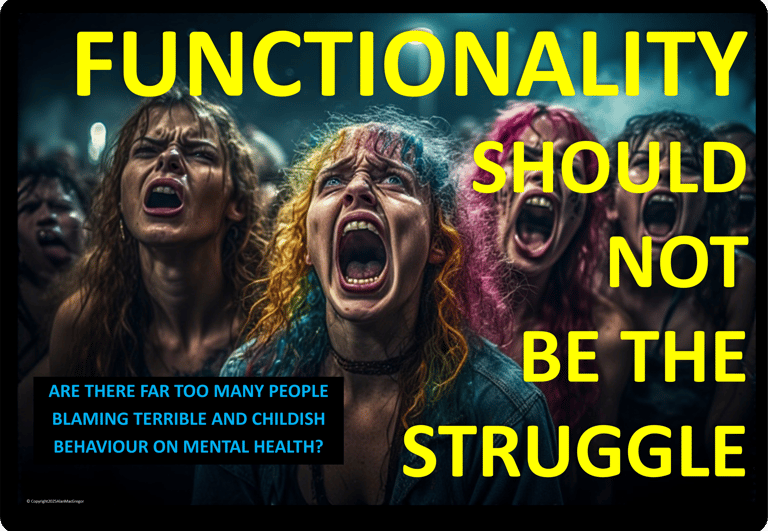
There is a quiet bargain that every functioning society makes with its people.
You are free.
But you are also expected to grow up.
That bargain used to be understood without being written down. It lived in households, workplaces, sporting clubs, pubs, churches, classrooms, factories. It lived in phrases that sound unfashionable now.
“Pull yourself together.”
“Deal with it.”
“Life’s hard.”
“Do better tomorrow.”
None of those phrases denied suffering. They assumed resilience.
Today, that bargain has been quietly shredded and replaced with something far more corrosive. A system that rewards fragility, monetises diagnosis, and treats normal human discomfort as pathology. A system that tells people they are broken first, capable second, and responsible last. If at all.
And then it wonders why functionality itself feels like a struggle.
The Watering Down of the Human Animal
Modern society didn’t become softer by accident.
It was redesigned that way.
Across governments, institutions, HR departments, education systems and health bureaucracies, a single philosophy has been smuggled in under the banner of “care”. It says that discomfort is damage. That adversity is trauma. That behavioural failure is illness. That accountability is cruelty.
The result is not compassion.
It is infantilisation.
We now live in a culture where emotional turbulence is treated like a medical emergency, where self-diagnosis is celebrated, and where resilience is quietly reframed as oppression. The human being is no longer seen as adaptable, robust, and capable of growth. He is seen as permanently at risk, permanently fragile, permanently in need of intervention.
This does not produce healthier people.
It produces dependent ones.
When a system teaches people that every internal discomfort must be externally managed, it creates a population that cannot regulate itself. When it medicalises normal stress responses, it trains citizens to outsource responsibility for their own behaviour. When it rewards identity through diagnosis, it guarantees the overuse of diagnosis.
And that is exactly what we are seeing.
Behaviour Rebranded as Illness
Let’s be precise, because precision matters here.
There are real mental illnesses.
There are real neurological disorders.
There are real psychological conditions that deserve serious, timely, compassionate care.
This piece does not mock them. It defends them.
What it roasts is the industrial-scale rebranding of poor behaviour, immaturity, entitlement, and avoidance as medical conditions.
Historically, many things were dealt with socially, not clinically.
A short fuse was a temper problem.
Lack of discipline was a character problem.
Avoidance was cowardice.
Self-obsession was narcissism.
Meltdowns were tantrums.
They were addressed with boundaries, consequences, mentorship, structure, and sometimes shame. Not the destructive kind, but the corrective kind. The kind that signals “this behaviour does not serve you or the group”.
Today, the same behaviours are often reinterpreted as symptoms.
Not because the science suddenly changed, but because the incentives did.
A diagnosis removes responsibility.
Medication removes effort.
A label provides protection.
A system provides validation.
And once those incentives exist, abuse is inevitable.
The Prescription Shortcut
We now live in a world where adults can obtain powerful psychiatric medications with astonishing ease.
No blood tests.
No objective biomarkers.
No scans.
No measurable proof.
Just self-reported feelings.
“I feel anxious.”
“I struggle to focus.”
“I feel overwhelmed.”
“I feel unsafe.”
Those statements may be true. They may also be exaggerated, situational, manipulative, or temporary. The system rarely distinguishes between them.
And so a shortcut emerges.
Why struggle through discomfort when you can medicate it?
Why build coping skills when you can suppress symptoms?
Why adapt when you can be excused?
Long-term use of medications originally designed for acute or severe conditions is now commonplace. Side effects are downplayed. Dependency is rarely discussed honestly. Emotional flattening, cognitive dulling, physical complications, sexual dysfunction, and withdrawal symptoms are often discovered the hard way.
This is not empowerment.
It is chemical avoidance dressed as care.
And the cruel irony is that the people who truly need help are pushed to the back of the queue by those who have learned how to game the system.
The Rise of the Professional Victim
Every system creates the behaviour it rewards.
When victimhood grants status, protection, and moral authority, it becomes a currency. When claiming harm carries more power than demonstrating competence, people will claim harm. When accountability is replaced with accommodation, abuse follows.
Certain activist-adjacent communities now operate as amplifiers for this dynamic. They encourage constant self-surveillance, endless introspection, and communal validation of dysfunction. Normal human struggle is framed as evidence of oppression. Recovery is secondary to recognition.
In these spaces, improvement can even be seen as betrayal. If you get better, you leave the group. If you cope, you no longer belong. If you overcome, you invalidate the narrative.
So people stay sick. Or at least claim to be.
The system claps.
Anxiety: The Get-Out-of-Responsibility Card
Few concepts have been abused more thoroughly than anxiety.
Anxiety is a real physiological response. It evolved to keep us alive. It sharpens attention, mobilises energy, and prepares the body for challenge.
It is not, by default, a disorder.
Yet today, anxiety has become the universal solvent. It dissolves accountability. It explains behaviour. It halts consequences. It even carries legal weight.
A person can now claim that another person’s words caused them anxiety, and that claim alone can trigger investigations, restrictions, or penalties. No objective test. No proof of causation. Just assertion.
An emotion becomes a weapon.
This is not justice. It is emotional coercion.
Worse still, it trains people to externalise their internal states. Instead of learning to regulate fear, they learn to regulate others. Instead of managing discomfort, they demand its removal from the environment.
A society that operates this way cannot function. It becomes paralysed by the most fragile among it.
Division by Design
This did not emerge organically.
When populations are encouraged to see themselves primarily through the lens of vulnerability, they fragment. Groups compete for recognition. Identities harden around grievance. Shared standards disappear.
Once-unifying concepts like resilience, maturity, and self-control are reframed as oppressive. Common expectations become negotiable. Standards become “harmful”.
And into that vacuum steps authority.
When people cannot self-regulate, they must be regulated. When communities cannot resolve conflict internally, it is escalated externally. When citizens lack internal strength, systems gain external power.
This is how soft authoritarianism grows. Not through jackboots, but through paperwork, policies, and “support frameworks”.
What Real Care Actually Looks Like
Real mental healthcare is demanding.
It involves truth-telling.
It involves discomfort.
It involves boundaries.
It involves effort.
It does not tell people they are helpless.
It does not tell them they are broken forever.
It does not build identity around illness.
It helps people function.
That means sometimes saying:
“This feeling is unpleasant, but survivable.”
“This behaviour is understandable, but unacceptable.”
“You are capable of more than this.”
Those statements are now considered harsh. In reality, they are respectful. They treat adults as adults.
The current system often does the opposite. It lowers expectations while claiming compassion. It removes agency while claiming empowerment. It creates dependence while claiming support.
And the bill is coming due.
The Cost of Clogged Care
Every abused system crowds out those who truly need it.
Emergency services overwhelmed by non-emergencies.
Clinicians buried in performative distress.
Resources diverted from severe cases to mild discomfort.
The people with schizophrenia, bipolar disorder, severe PTSD, profound depression, and genuine neurological impairments suffer quietly while the system attends to the loudest, not the sickest.
That is not kindness.
It is negligence.
Rebuilding Functionality
Functionality should not be revolutionary.
It should not require a diagnosis.
It should not require permission.
It should not require a label.
It begins with restoring a few unfashionable ideas.
That humans are resilient by design.
That discomfort is part of growth.
That behaviour matters.
That responsibility is empowering.
A society that cannot say “no” to dysfunction will eventually say “yes” to control.
A society that teaches people to cope will always outperform one that teaches them to collapse.
Final Word
This is not a call to cruelty.
It is a call to courage.
To stop confusing care with coddling.
To stop rewarding avoidance.
To stop mistaking fragility for virtue.
We do not need fewer strong people.
We need fewer systems that punish strength.
Functionality should not be the struggle.
And the fact that it has become one tells us everything we need to know.
– Alan MacGregor
Perth Proclaimer
Join Perth Proclaimer for community news.
be awake
© 2025 Alan MacGregor. All rights reserved.
learn the truth
stay vigilant
stop the fear